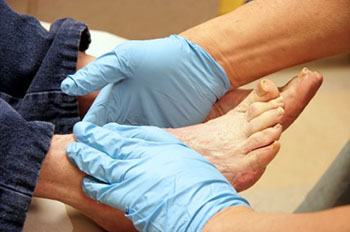
Foot and ankle problems usually fall into the following categories:

  • Acquired from improper footwear, physical stress, or small mechanical changes within the foot.
  • Arthritic foot problems, which typically involve one or more joint.
  • Congenital foot problems, which occur at birth, are generally inherited.
  • Infectious foot problems, which are caused by bacterial, viral, or fungal disorders.
  • Neoplastic disorders, usually called tumors, which are the result of abnormal growth of tissue and may be benign or malignant.
  • Traumatic foot problems, which are associated with foot and ankle injuries.

The top foot problems are:

  • Bunions - misaligned big toe joints that can become swollen and tender, causing the first joint of the big toe to slant outward, and the second joint to angle toward the other toes. Bunions tend to be hereditary, but can be aggravated by shoes that are too narrow in the forefoot and toe. Surgery is frequently performed to correct the problem.
  • Hammertoe - a condition, usually stemming from muscle imbalance, in which the toe is bent in a claw-like position. It occurs most frequently with the second toe, often when a bunion slants the big toe toward and under it, but any of the other three smaller toes can be affected. Selecting shoes and socks that do not cramp the toes will alleviate aggravation.
  • Heel spurs - growths of bone on the underside, forepart of the heel bone. Heel spurs occur when the plantar tendon pulls at its attachment to the heel bone. This area of the heel can later calcify to form a spur. With proper warm-up and the use of appropriate athletic shoes, strain to the ligament can be reduced.
  • Ingrown nails - toenails whose corners or sides dig painfully into the skin. Ingrown toenails are frequently caused by improper nail trimming, but also by shoe pressure, injury, fungus infection, heredity and poor foot structure. Women are much more likely to have ingrown toenails than men. Ingrown nails can be prevented by trimming toenails straight across, selecting proper shoe style and size - not too tapered or shallow - and paying special attention to foot pain.
  • Neuromas - enlarged benign growths of nerves, most commonly between the third and fourth toes. They are caused by tissue rubbing against and irritating the nerves. Pressure from ill-fitting shoes or abnormal bone structure can also lead to this condition. Treatments include orthoses (shoe inserts) and/or cortisone injections, but surgical removal of the growth is sometimes necessary.
  • Plantar fasciitis (heel pain) - usually caused by an inflammation on the bottom of the foot. Our practice can evaluate arch pain, and may prescribe customized shoe inserts called orthoses to help alleviate the pain.
  • Sesamoiditis - inflammation or rupture of the two small bones (sesamoids) under the first metatarsal bones. Proper shoe selection and orthoses can help.
  • Shin splints - pain to either side of the leg bone, caused by muscle or tendon inflammation. It is commonly related to excessive foot pronation (collapsing arch), but may be related to a muscle imbalance between opposing muscle groups in the leg. Proper stretching and corrective orthoses (shoe inserts) for pronation can help prevent shin splints.
  • Stress fractures -incomplete cracks in bone caused by overuse. With complete rest, stress fractures heal quickly. Extra padding in shoes helps prevent the condition. Stress fractures left untreated may become complete fractures, which require casting and immobilization.


The Achilles tendon is the largest tendon in the human body and can withstand forces of 1,000 pounds or more. It also is the most frequently ruptured tendon, usually as a result of a sports injury. Both professional and weekend athletes may suffer from Achilles tendonitis, a common overuse injury and inflammation of the tendon.


Events that can cause Achilles tendonitis may include:

  • Hill running or stair climbing.
  • Overuse, stemming from the natural lack of flexibility in the calf muscles.
  • Rapidly increasing mileage or speed when walking, jogging, or running.
  • Starting up too quickly after a layoff in exercise or sports activity, without adequately stretching and warming up the foot.
  • Trauma caused by sudden and/or hard contraction of the calf muscles when putting out extra effort, such as in a sprint.
  • Improper footwear and/or a tendency toward overpronation.

Achilles tendonitis often begins with mild pain after exercise or running that gradually worsens. Other symptoms include:

  • Recurring localized pain, sometimes severe, along the tendon during or a few hours after running.
  • Morning tenderness about an inch and a half above the point where the Achilles tendon is attached to the heel bone.
  • Sluggishness in your leg.
  • Mild or severe swelling.
  • Stiffness that generally diminishes as the tendon warms up with use.

Treatment normally includes:

  • A bandage specifically designed to restrict motion of the tendon.
  • Taking nonsteroidal anti-inflammatory medication for a period of time. Note: Please consult your physician before taking any medication.
  • Orthotics, which are corrective shoe inserts designed to help support the muscle and relieve stress on the tendon. Both nonprescription orthoses (such as a heel pads or over-the-counter shoe inserts) and prescribed custom orthotics may be recommended depending on the length and severity of the problem.
  • Rest and switching to exercises that do not stress the tendon (such as swimming).
  • Stretching and exercises to strengthen the weak muscle group in front of the leg, calf, and the upward foot flexors, as well as massage and ultrasound.

In extreme cases, surgery is performed to remove the fibrous tissue and repair any tears.


Ankle sprains are caused by an unnatural twisting or force on the ankle bones of the foot, which may result in excessive stretching or tearing of one or more ligaments on the outside of the ankle. The severity of the sprain can impact the degree of damage as well as the type and duration of treatment. If not properly treated, ankle sprains may develop into long-term problems.


Primary symptoms of ankle sprains are pain following a twist or injury, swelling, and bruising.


Treatment includes resting and elevating the ankle and applying ice to reduce swelling. Compressive bandages also may be used to immobilize and support the injury during healing. Serious ankle sprains, particularly among competitive athletes, may require surgery to repair and tighten the damaged ligaments.


To prevent ankle sprains, try to maintain strength, balance, and flexibility in the foot and ankle through exercise and stretching, and wearing well-fitted shoes.


Flat feet are a common condition of the foot structure. In infants and toddlers, prior to walking, the longitudinal arch is not developed and flat feet are normal. Most feet are flexible and an arch appears when children begin standing on their toes. The arch continues to develop throughout childhood, and by adulthood most people have developed normal arches.

Flat feet are generally associated with pronation, a leaning inward of the ankle bones toward the center line. Shoes of children who pronate, when placed side by side, will lean toward each other (after they have been worn long enough for the foot position to remodel their shape).

Many people with flat feet do not experience pain or other problems. When pain in the foot, ankle, or lower leg does occur, especially in children, the feet should be evaluated.

Painful progressive flatfoot, otherwise known as tibialis posterior tendonitis or adult-acquired flatfoot, refers to inflammation of the tendon of the tibialis posterior. This condition arises when the tendon becomes inflamed, stretched, or torn. Left untreated, it may lead to severe disability and chronic pain. People are predisposed to tibialis posterior tendonitis if they have flat feet or an abnormal attachment of the tendon to the bones in the midfoot.

Nonsteroidal anti-inflammatory medications, icing, physical therapy, supportive taping, bracing, and orthotics are common treatments for painful progressive flatfoot. Note: Please consult your physician before taking any medications. In some cases, a surgery may need to be performed to repair a torn or damaged tendon and restore normal function. In the most severe cases, surgery on the midfoot bones may be necessary to treat the associated flatfoot condition.


Nearly one-fourth of all the bones in your body are in your feet. A broken (fractured) bone in your forefoot or in one of your toes is often painful, but rarely disabling. Most of the time, these injuries heal without operative treatment.


There are two types of foot fractures: stress fractures and general bone fractures. Stress fractures usually occur in the bones of the forefoot extending from the toes to the middle of the foot. Stress fractures are like tiny cracks in the bone surface. They can happen with sudden increases in exercise (such as running or walking for longer distances or times), improper training techniques, or a change in surfaces.


Most other types of fractures extend through the bone, and are called bone fractures. They may be stable, in which there is no shift in bone alignment, or displaced, in which the bone ends no longer line up properly. Bone fractures usually result from trauma, such as dropping a heavy object on your foot, or from a twisting injury. If the fractured bone does not break through the skin, it is called a closed fracture. If the fracture does break through the skin, it is called an open fracture.


Because of the complex structures in the foot, there are some other, more specific types of fractures that can occur. For example, the fifth metatarsal, known as the little or pinky toe, is susceptible to a variety of different fractures. The relationship between the ankle and the foot can be compromised by an ankle-twisting injury, which may tear the tendon that attaches to this bone and pull a small piece of the bone away. A more serious injury in the same area is known as a Jones fracture, which occurs near the base of the bone and disrupts its blood supply. This injury may take longer to heal or require surgery.


Common symptoms for any type of foot fracture includes pain, swelling, and sometimes bruising. Be sure to seek medical attention for any suspected foot fracture.


Fungal nails refers to any number of fungal nail infections that can occur on the foot. Since fungal nails are usually more resistant and more difficult to treat than Athlete's Foot, topical or oral antifungal medications may be prescribed. Note: Please consult a physician before taking any medications. Permanent nail removal is another possible form of treatment for tenacious fungal nails.

Preventing Fungal Nail Infections

After a fungal nail infection has cleared up, take steps to prevent the infection from recurring. Keeping fungi at bay will help prevent a fungal infection of the skin from reinfecting the nail. Before bed, thoroughly wash and dry your feet, and apply a nonprescription antifungalantifungal cream to the entire foot from the ankle down. Use the cream every night, then gradually apply it less often. Keep your feet dry. Dry feet are less likely to become infected. Apply powder to your dry feet after you take a shower or bath.

Other suggestions for preventing fungal nails include:

  • Don't share nail clippers or nail files with others.
  • Don't share shoes or socks with others.
  • Try not to injure your nail, such as by cutting it too short (trauma to the nail may lead to infections).
  • Wear dry cotton socks and change them two or three times a day if necessary.
  • Wear dry shoes that allow air to circulate around your feet (tight, enclosed, moist shoes contribute to fungal toenail infections).
  • Wear shower sandals or shower shoes when you are at a public pool or shower.

Prevention

Follow basic foot care guidelines and, more than likely, you can head off most common foot fungus problems.


According to the American Diabetes Association, about 15.7 million people (5.9 percent of the United States population) have diabetes. Nervous system damage (also called neuropathy) affects about 60 to 70 percent of people with diabetes and is a major complication that may cause diabetics to lose feeling in their feet or hands.

Foot problems are a big risk in diabetics. Diabetics must constantly monitor their feet or face severe consequences, including amputation.

With a diabetic foot, a wound as small as a blister from wearing a shoe that's too tight can cause a lot of damage. Diabetes decreases blood flow, so injuries are slow to heal. When your wound is not healing, it's at risk for infection. As a diabetic, your infections spread quickly. If you have diabetes, you should inspect your feet every day. Look for puncture wounds, bruises, pressure areas, redness, warmth, blisters, ulcers, scratches, cuts and nail problems. Get someone to help you, or use a mirror.

Here's some basic advice for taking care of your feet:

  • Always keep your feet warm.
  • Don't get your feet wet in snow or rain.
  • Don't put your feet on radiators or in front of the fireplace.
  • Don't smoke or sit cross-legged. Both decrease blood supply to your feet.
  • Don't soak your feet.
  • Don't use antiseptic solutions, drugstore medications, heating pads or sharp instruments on your feet.
  • Trim your toenails straight across. Avoid cutting the corners. Use a nail file or emery board. If you find an ingrown toenail, contact our office.
  • Use quality lotion to keep the skin of your feet soft and moist, but don't put any lotion between your toes.
  • Wash your feet every day with mild soap and warm water.
  • Wear loose socks to bed.
  • Wear warm socks and shoes in winter.
  • When drying your feet, pat each foot with a towel and be careful between your toes.
  • Buy shoes that are comfortable without a "breaking in" period. Check how your shoe fits in width, length, back, bottom of heel, and sole. Avoid pointed-toe styles and high heels. Try to get shoes made with leather upper material and deep toe boxes. Wear new shoes for only two hours or less at a time. Don't wear the same pair every day. Inspect the inside of each shoe before putting it on. Don't lace your shoes too tightly or loosely.
  • Choose socks and stockings carefully. Wear clean, dry socks every day. Avoid socks with holes or wrinkles. Thin cotton socks are more absorbent for summer wear. Square-toes socks will not squeeze your toes. Avoid stockings with elastic tops.

When your feet become numb, they are at risk for becoming deformed. One way this happens is through ulcers. Open sores may become infected. Another way is the bone condition Charcot (pronounced "sharko") foot. This is one of the most serious foot problems you can face. It warps the shape of your foot when your bones fracture and disintegrate, and yet you continue to walk on it because it doesn't hurt. Diabetic foot ulcers and early phases of Charcot fractures can be treated with a total contact cast.

The shape of your foot molds the cast. It lets your ulcer heal by distributing weight and relieving pressure. If you have Charcot foot, the cast controls your foot's movement and supports its contours if you don't put any weight on it. To use a total contact cast, you need good blood flow in your foot. The cast is changed every week or two until your foot heals. A custom-walking boot is another way to treat your Charcot foot. It supports the foot until all the swelling goes down, which can take as long as a year. You should keep from putting your weight on the Charcot foot. Surgery is considered if your deformity is too severe for a brace or shoe.